What is prompt engineering? A beginner’s guide.
Prompt engineering is the practice of designing the inputs you give to a large language model so it produces the output you want. Here\u2019s what that means, why it matters, and the techniques that work in 2026.



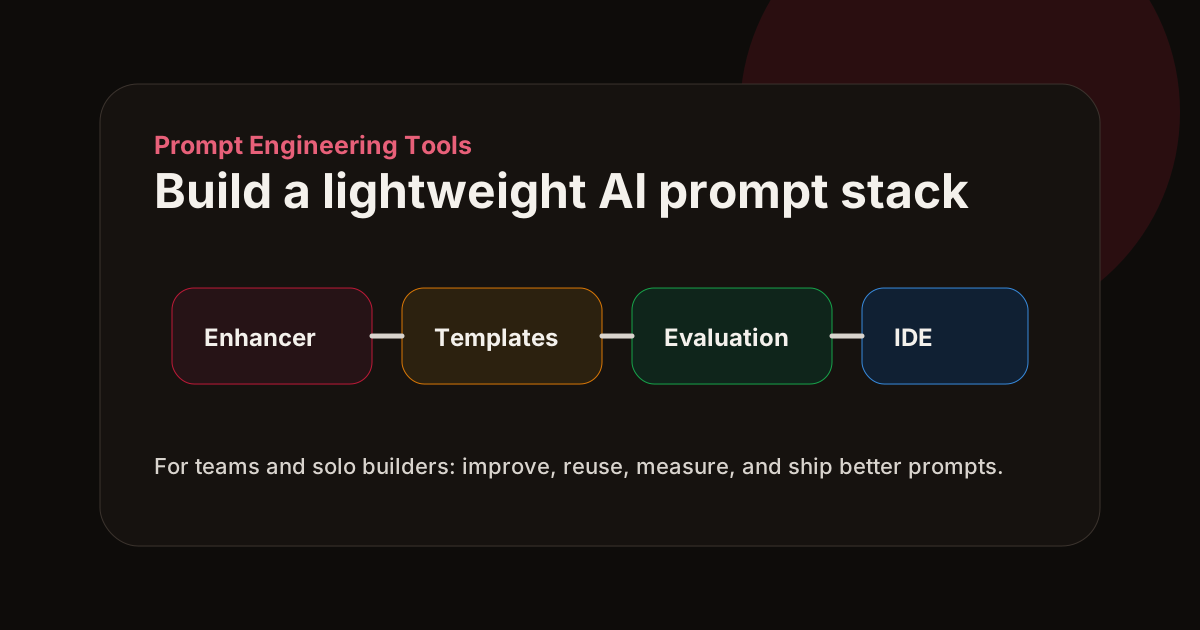
Prompt engineering = designing inputs for LLMs.
A large language model is a probabilistic system: it produces the most likely output given an input. Prompt engineering is the practice of designing that input — its structure, examples, constraints and context — so the most likely output is the one you want.
It is not magic, it is not coding, and you do not need a PhD. It is a small set of repeatable techniques that anyone can learn in an afternoon and apply to ChatGPT, Claude, Gemini or any other LLM.
The five techniques every prompt engineer uses.
- 01
01Zero-shot prompting
Just ask. No examples, no chain-of-thought. The simplest form — and surprisingly effective for clear, well-scoped tasks where the model has strong priors.
- 02
02Few-shot prompting
Provide 1-3 examples of the input-output pattern you want, then ask the model to apply it to a new input. The biggest single quality lift for creative and classification tasks.
- 03
03Chain-of-thought prompting
Ask the model to "think step by step" before answering. Improves math, logic and multi-step reasoning by a measurable margin on GPT-4o, Claude 3.5 and Gemini 2.0.
- 04
04Role prompting
Assign the model a role: "You are a senior backend engineer reviewing a PR." Primes vocabulary, depth and tone without changing the underlying model.
- 05
05Constraint prompting
Add explicit guardrails — what to avoid, what to never do, what format to never deviate from. Prevents the most common failure modes upfront.
Six reasons prompt engineering is a real skill.
Same model, different prompts can produce 10x different output quality on real tasks.
Within a model tier, prompt quality explains more variance than model choice.
Prompt engineer / AI engineer roles at every major AI lab and a growing share of enterprises.
What you learn on ChatGPT works in Claude, Gemini, Mistral, Llama and future models.
Where it shows up in your day job.
Engineers
Design system prompts, build evaluation suites, ship retrieval-augmented generation and tool-use pipelines.
Product managers
Spec AI features, write the system prompt that defines product personality, run A/B tests on prompt variants.
Students
Get personalized explanations, generate practice questions, Socratic feedback on essays — faster learning, not skipping it.
Writers
Use AI for outlines, voice rewrites, summarization. Prompt engineering keeps the model in your voice instead of generic prose.
Researchers
Synthesize literature, draft methodology, classify findings. Strong prompts cut review time without sacrificing rigour.
Operators
Automate customer support, summarize tickets, draft policy responses — strong prompts replace 80% of the rules-based logic.
Common questions.
Try prompt engineering on a real prompt.
See the techniques in action: paste any prompt and AI Prompt Fixer will apply role, audience, format and constraint patterns automatically.